1
Choose the round settings
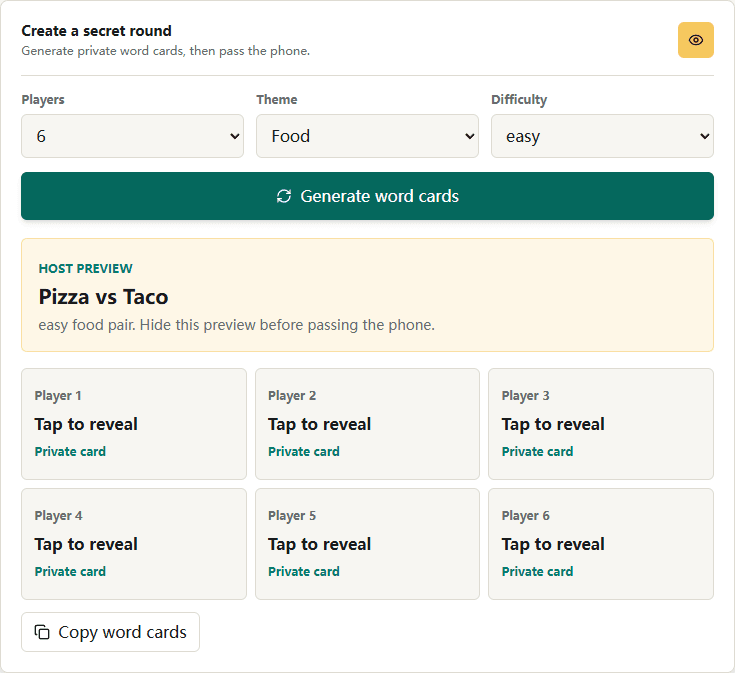
Set the player count, pick a theme, and choose a difficulty everyone at the table will understand.
Complete rules guide
Most players receive the same secret word. One hidden Imposter receives a related word and must blend in through clues, discussion, and the final vote.
Minimal setup
There is no board, account, or download. Gather the group around one screen and start with an easy pair for the first round.
Private card setup
Set the player count, pick a theme, and choose a difficulty everyone at the table will understand.

The host sees one related pair, such as Pizza vs Taco. Hide this preview before passing the device.

Hand the device to each player. Only the person holding it should tap their numbered card.

Regular players receive the normal word. One randomly assigned Imposter receives the related hidden word.
Round flow
Go around the table once. Each player gives one short clue without saying either secret word.
Notice vague answers, copied ideas, and clues that fit the related word better than the normal word.
Ask players to explain suspicious clues. The Imposter tries to learn the normal word and redirect attention.
Vote at the same time. Reveal the Imposter, then show both words and compare the clues.
Eight winning tactics
Keep rounds fair
Change the format
Use two hidden players for groups of eight or more.
Ask one short question instead of giving single-word clues.
Split a large group into teams and submit one vote per team.
A caught Imposter can still win by naming the normal word.
Better word choices
The word pair decides whether the round feels clever or random. A fair pair is related enough that the imposter can bluff, but different enough that regular players can give clues with real meaning.
Use easy food, animal, and place pairs for children, first-time players, or large groups.
Easy food pairsUse medium and hard pairs when players understand the clue rules and enjoy close distinctions.
Hard place pairsUse expert vocabulary only when every player knows the words well enough to give specific clues.
Expert people pairsReady for the first round?
Choose the player count, theme, and difficulty, then pass one device around so everyone can reveal a private card. The same tool also runs the clue timer, vote, result reveal, score, and next round without leaving this guide.
Run a complete imposter round
Cards, timer, voting, reveal, scoring, and next round.
easy food pair. Keep this section closed before passing the phone.
Win rule: regular players score by voting out the imposter. The imposter scores if another player is voted out.
Prefer a dedicated full-screen setup? Open the online Imposter game generator.
Rules questions
Four to ten players is the easiest range, although three can work. With more than ten players, split into two tables or add a second Imposter.
Most rounds take five to ten minutes: one minute to reveal cards, two or three minutes for clues, and a short discussion and vote.
No player should say either secret word directly. The Imposter should give a related clue and try to infer the normal word from everyone else's answers.
Run a quick second vote between the tied players. If the group ties again, count it as an Imposter escape or play one final clue round.
Yes. Use easy food, animal, place, or people pairs, allow short sentence clues, and keep discussion friendly.
For background on social deduction games, see the classic Mafia/Werewolf party game.